James Tower
James Tower was one of the most original figures in post-war British studio ceramics, occupying a distinctive position between painting, sculpture and ceramics. Working at the intersection of abstraction and the ceramic vessel, he developed a highly individual visual language inspired by landscape, natural forms and the rhythms of the sea. His innovative approach helped demonstrate the expressive and sculptural potential of clay, establishing him as an important contributor to the development of twentieth-century British studio ceramics.
Register a Wishlist for James Tower
Tower was born in Sheerness, Kent, in 1919. He initially trained as a painter at the Royal Academy Schools (1938–40), where he was awarded the Royal Academy Gold Medal for Painting in 1939. Following service during the Second World War, he studied at the Slade School of Fine Art before taking ceramics classes with Dora Billington and William Newland at the London Institute, experiences that laid the foundation for his lifelong engagement with clay.
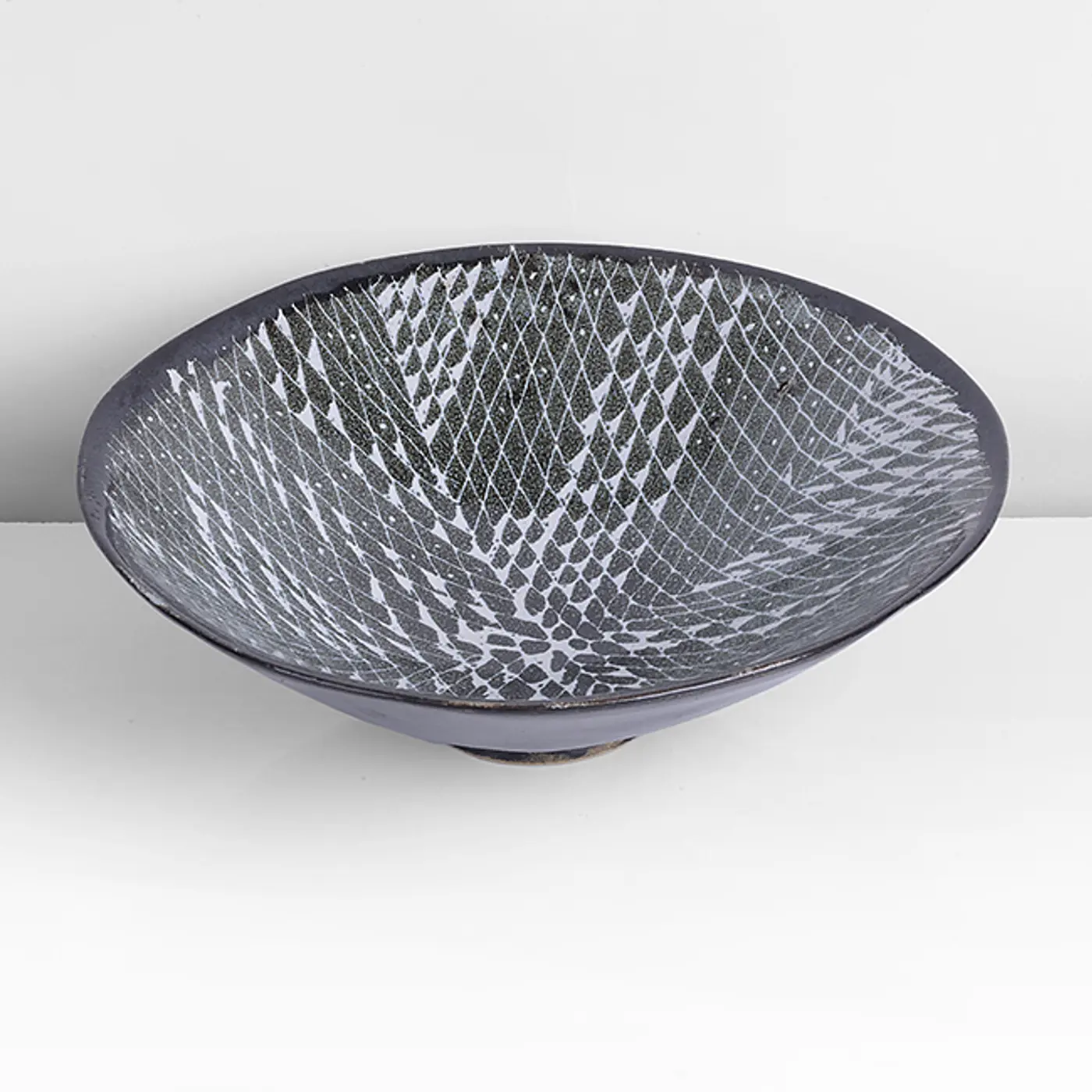
Although he worked across painting, sculpture and ceramics throughout his career, Tower is best known for his distinctive earthenware vessels, platters and sculptural forms. Drawing upon the traditions of English slipware and tin-glazed pottery, he transformed functional ceramic forms into highly personal abstract compositions, often evoking shells, leaves, fish, coastlines and geological formations. Teaching at the progressive Bath Academy of Art from 1949 and later serving as Head of Fine Art at Brighton College of Art from 1966, he was closely associated with the development of post-war British abstraction while maintaining an independent artistic vision that set him apart from both the Leach tradition and mainstream modernist sculpture.
Tower exhibited regularly with the influential London gallery Gimpel Fils from 1951 throughout his career and held numerous solo exhibitions in Britain and internationally. His work is represented in major public collections including the Victoria and Albert Museum, London, the Art Institute of Chicago and the Victoria Art Gallery, Bath, among others. His achievements were recognised early with the Royal Academy Gold Medal for Painting and later by a Leverhulme Research Award. Since his death, retrospective exhibitions and scholarly publications have continued to reinforce his reputation as one of the leading innovators in twentieth-century British ceramics.
Artwork


